
Positive Power & Influence®
Help leaders and professionals influence decisions, build stakeholder commitment, and move work forward without relying on formal authority.
A practical, behavior-based model for adapting how professionals communicate, build participation, and gain commitment across complex workplace situations.
Schedule a Consultation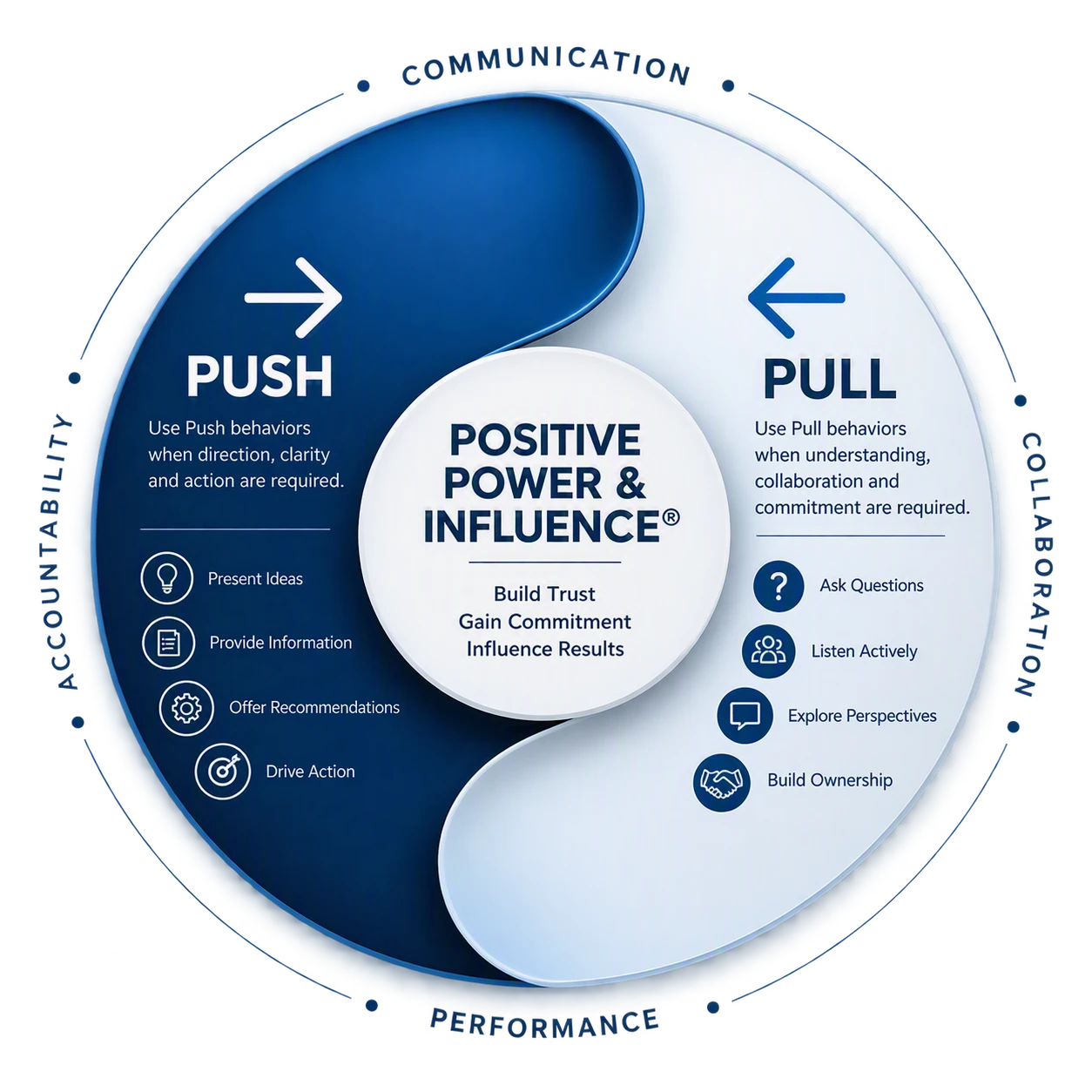
Adapt Your Influence to the Situation
Effective influence requires more than relying on one preferred communication style. Positive Power & Influence® helps professionals choose behaviors that fit the people involved, the workplace situation, and the outcome they need to achieve.
Build Trust
Strengthen the credibility and relationships needed for productive cooperation.
Gain Commitment
Create genuine ownership and support for decisions and initiatives.
Improve Communication
Combine clear messages with purposeful questions and active listening.
Move Work Forward
Turn recommendations into supported decisions and coordinated action.
Balance Direction and Participation
Positive Power & Influence® uses two complementary approaches. Push behaviors help you lead with clarity and direction. Pull behaviors help you create understanding, participation, and ownership.
Push: Provide Direction
With Push, you put forward your position and guide the conversation toward a clear outcome. Use it when others need expectations, ideas, evidence, or a recommended course of action.
- State expectations
- Present ideas
- Provide reasoning
- Recommend action
Pull: Build Participation
With Pull, you create space for others to contribute and become involved in the outcome. Use it when understanding perspectives, addressing concerns, or building ownership is essential.
- Ask questions
- Listen actively
- Explore perspectives
- Build ownership
Four Behaviors That Put the Model into Practice
The model translates Push and Pull into four observable behaviors: Assertiveness and Reasoning provide direction, while Inquiry and Empathy build understanding and participation.
Assertiveness
Clearly communicate expectations, boundaries, positions, and requests.
Reasoning
Support ideas and recommendations with relevant evidence and logical connections.
Inquiry
Use purposeful questions to understand perspectives, needs, and concerns.
Empathy
Demonstrate understanding by listening attentively and acknowledging others’ perspectives.
Where the Model Adds Value
Positive Power & Influence® helps professionals adapt how they influence when progress depends on understanding different perspectives, strengthening working relationships, and building commitment.
Leadership
Communicate direction and build commitment around team and organizational priorities.
Stakeholder Relationships
Respond effectively to different priorities, expectations, and levels of support.
Cross-Functional Collaboration
Strengthen cooperation and coordinated action across teams with different responsibilities.
Organizational Change
Balance clear direction with the participation needed to support implementation.
See Positive Power & Influence® in Action
A global organization used Positive Power & Influence® to address competing priorities, inconsistent collaboration, and difficulty building commitment across organizational boundaries.
The Challenge
Teams needed a more consistent way to align stakeholders with different priorities and maintain momentum across functions.
The Approach
Participants applied practical influence behaviors to current stakeholder relationships, workplace decisions, and strategic initiatives.
Common Questions About Positive Power & Influence®
What is the Positive Power & Influence® model?
Positive Power & Influence® is a practical framework that helps professionals use different influence behaviors according to the situation, the people involved, and the outcome they need to achieve.
What is the difference between Push and Pull influence behaviors?
Push behaviors provide clarity and direction by expressing positions, reasoning, expectations, or recommendations. Pull behaviors build understanding and participation by asking questions, listening, and exploring perspectives.
Is Push or Pull better for influencing at work?
Neither approach is inherently better. Effectiveness depends on selecting and balancing the behaviors that best fit the situation, relationship, and desired outcome.
What are the four core behaviors in the model?
The model uses four observable behaviors: Assertiveness and Reasoning within Push, and Inquiry and Empathy within Pull.
Does APRENDA offer training based on this model?
Yes. APRENDA offers practical influence skills training connected to workplace situations, stakeholder relationships, and organizational priorities.
Develop More Adaptable Influencers
APRENDA helps organizations develop and apply Positive Power & Influence® behaviors through practical training connected to real workplace situations, stakeholder relationships, and organizational priorities.
Schedule a Consultation →